
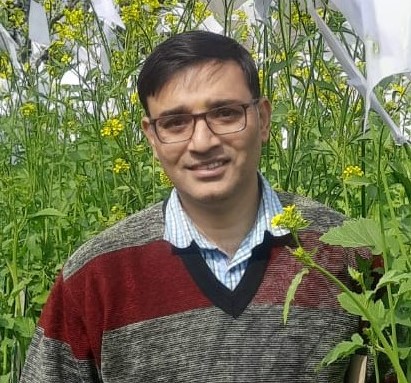
Naveen C. Bisht
Professor
Education and Research Experience:
- B.Sc. (Gen B), Hansraj College, Univ of Delhi, Delhi (1994–1997)
- M.Sc. (Mol Biol & Biotech), G B Pant Univ of Agri & Tech, Pantnagar (1997–1999)
- Ph.D., Dept of Genetics, Univ of Delhi South Campus (UDSC), New Delhi (2000–2005)
- Postdoctoral Fellow, Dept of Genetics, UDSC, New Delhi (Feb–Dec 2005)
- Research Scientist, CGMCP, UDSC, New Delhi (Jan 2006–Feb 2007)
- Scientist, BRIC-National Institute of Plant Genome Research (BRIC-NIPGR), New Delhi (Mar 2007–Aug 2026)
- Visiting Scientist, Donald Danforth Plant Science Centre, USA (2008–2010)
Research Interests:
Investigating the molecular and genetic basis of seed quality traits in Indian oilseed mustard
High amounts of glucosinolates, erucic acid, and several other seed metabolites, such as phytic acid and sinapine, in Brassica oilseeds are considered anti-nutritional and reduce oil and meal quality. The laboratory is working on the identification and fine mapping of QTL/genes regulating seed quality traits in Indian oilseed mustard using a combination of transcriptome and genome-wide association analyses in natural populations and doubled haploids (DH). In the quest to improve the flavor and nutritional qualities of Brassica oilseed crops, the lab in collaboration with CGMCP, UDSC is targeting genes/proteins involved in the biosynthesis and transport of glucosinolates, fatty acid composition, and other anti-nutritional metabolites using CRISPR/Cas9 and transgenic-based approaches.
Understanding the role of glucosinolates-myrosinase system in plant defense
Glucosinolates constitute a major chemical defense system, specifically present in the Brassicaceae crops. Upon tissue damage, they are hydrolyzed by endogenous myrosinases (β-thioglucoside glucohydrolases) to produce a diverse array of biologically active breakdown products, including isothiocyanates, nitriles, epithionitriles and thiocyanates. The nature of these hydrolysis products determines the ecological, nutritional, and biological functions of the glucosinolate–myrosinase defense system. Tissue-specific manipulation of glucosinolate accumulation and profiles is a promising strategy for engineering insect and pest resistance in Brassica crops. The role of glucosinolate-negotiated plant defense is being researched. Additionally, key pathogen proteins involved in Sclerotinia-Brassica interactions are being identified and functionally characterized to understand the disease mechanism in depth.
- Kumar P, Bisht NC (2025) High-level production of health-beneficial glucoraphanin by multiplex editing of the AOP2 gene family in mustard. Plant Biotechnology Journal 23: 4668–4680. DOI:10.1111/pbi.70171 (cover page article of PBJ Vol. 23 (10), Oct. 2025)
- Varghese M, Kumar R, Sharma A, Lone A, Gershenzon J, Bisht NC (2025) Isopropylmalate synthase regulatory domain removal abolishes feedback regulation at the expense of leucine homeostasis in plants. Plant Physiology 197(2): kiaf041. DOI:10.1093/plphys/kiaf041
- Tiwari R, Garg K, Senthil-Kumar M, Bisht NC (2024) XLG2 and CORI3 function additively to regulate plant defense against the necrotrophic pathogen Sclerotinia sclerotiorum. The Plant Journal 117(2): 616–631. DOI:10.1111/tpj.16518
- Mann A, Kumari J, Kumar R, Kumar P, Pradhan AK, Pental D, Bisht NC (2023) Targeted editing of multiple homologs of GTR1 and GTR2 genes provides the ideal low-seed, high-leaf glucosinolate oilseed mustard with uncompromised defense and yield. Plant Biotechnology Journal 21(11): 2182–2195 (Cover page article of PBJ Vol. 21(11), Nov. 2023)
- Tiwari R, Kaur J, Bisht NC (2021) Extra-large G-proteins influence plant response to Sclerotinia sclerotiorum by regulating glucosinolate metabolism in Brassica juncea. Molecular Plant Pathology 22: 1180–1194.
- Arya GC, Tiwari R, Bisht NC (2021) A complex interplay of Gβ and Gγ proteins regulates plant growth and defence traits in the allotetraploid Brassica juncea. Plant Molecular Biology 106: 505–520.
- Nambiar DM, Kumari J, Augustine R, Kumar P, Bajpai PK, Bisht NC (2021) GTR1 and GTR2 transporters differentially regulate tissue-specific glucosinolate contents and defence responses in the oilseed crop Brassica juncea. Plant Cell & Environment 44, 2729–2743.
- Gohain B, Kumar P, Malhotra B, Augustine R, Pradhan AK, Bisht NC (2021) A comprehensive Vis-NIRS equation for rapid quantification of seed glucosinolate content and composition across diverse Brassica oilseed chemotypes. Food Chemistry 354, 129527.
- Paritosh K, Yadava SK, Singh P, Bhayana L, Mukhopadhyay A, Gupta V, Bisht NC, Zhang J, Kudrna D, Copetti D, Wing RA, Reddy VB, Pradhan AK, Pental D (2021) A chromosome-scale assembly of allotetraploid Brassica juncea (AABB) elucidates comparative architecture of the A and B genomes. Plant Biotechnology Journal 19, 602–614.
- Kumar R, Bisht NC (2020) Heterotrimeric Gα subunit regulates plant architecture, organ size and seed weight in the oilseed Brassica juncea. Plant Molecular Biology 104, 549–560.
- Kumar R, Lee SL, Augustine R, Reichelt M, Vassão DG, Palavalli MH, Allen A, Gershenzon J, Jez JM, Bisht NC (2019) Molecular basis of the evolution of methylthioalkylmalate synthase and diversity of methionine-derived glucosinolates. The Plant Cell 31: 1633–1647.
- Bajpai PK, Reichelt M, Augustine R, Gershenzon J, Bisht NC (2019). Heterotic patterns of primary and secondary metabolites in the oilseed crop Brassica juncea. Heredity 123: 318–336.
- Kumar P, Augustine R, Singh AK, Bisht NC (2017) Feeding behaviour of generalist pests on Brassica juncea: implication for manipulation of glucosinolate biosynthesis pathway for enhanced resistance. Plant Cell & Environment 40: 2109–2120.
- Augustine R, Bisht NC (2015) Biofortification of oilseed Brassica juncea with the anti-cancer compound glucoraphanin by suppressing GSL-ALK gene family. Scientific Reports 5: 18005
- Augustine R, Majee M, Gershenzon J, Bisht NC (2013) Four genes encoding MYB28, a major transcriptional regulator of aliphatic glucosinolate pathway are differentially expressed in the allopolyploid Brassica juncea. Journal of Experimental Botany 64: 4907–4921.
- Augustine R, Mukhopadhyay A, Bisht NC (2013) Targeted silencing of BjMYB28 transcription factor gene directs development of low glucosinolate lines in oilseed Brassica juncea. Plant Biotechnology Journal 11: 855–866.
- Bisht NC, Jez JM, Pandey S (2011) An elaborate heterotrimeric G-protein family from soybean expands the diversity of plant G-protein networks. New Phytologist 190: 35–48.
- Bisht NC, Gupta V, Ramchiary N, Sodhi YS, Mukhopadhyay A, Arumugam N, Pental D, Pradhan AK (2009) Fine mapping of loci involved with glucosinolate biosynthesis in oilseed mustard (Brassica juncea) using genomic information from allied species. Theoretical & Applied Genetics 118: 413–421.
- Ramchiary N*, Bisht NC*, Gupta V*, Mukopadhyay A*, Arumugam N*, Sodhi YS, Pental D, Pradhan AK (2007) QTL analysis reveals context-dependent loci for seed glucosinolate trait in oilseed Brassica juncea: Importance of recurrent selection backcross scheme for the identification of ‘true’ QTL. Theoretical & Applied Genetics 116: 77–85 (*equal contribution)
- Bisht NC, Jagannath A, Gupta V, Burma PK, Pental D (2004) A two gene-two promoter system for enhanced expression of a restorer gene (barstar) and development of improved fertility restorer lines for hybrid seed production in crop plants. Molecular Breeding 14:129–144
- Kumari J, Mann A, Kumar R, Bisht NC. Recombinant expression cassettes for modification of glucosinolate content in plants. Indian Patent application no. 202211034971 (filed 17.06.22); PCT no. WO 2023/242872 (Published on 21.12.2023); Australian Patent application no. 2023290708 (filed 29.11.2024); Canadian Patent application no. 3259474 (filed 13.12.2024).
- Bisht NC and Augustine R. Compositions and methods for production of transgenic plants having reduced glucosinolate levels. Indian Patent 411478 (granted on 15.11.2022).
- Bisht NC, Jagannath A, Gupta V, Burma PK and Pental D. A novel method for obtaining improved fertility restorer lines for transgenic male-sterile crop plants and a DNA construct for use in said method. US Patent 7741541 (granted on 22.06.2010).
- Bisht NC, Jagannath A, Gupta V, Burma PK and Pental D. A novel method for obtaining improved fertility restorer lines for transgenic male-sterile crop plants and a DNA construct for use in said method. European Patent 1644506 (granted on 09.09.2009).
- Bisht NC, Jagannath A, Gupta V, Burma PK and Pental D. A novel method for obtaining improved fertility restorer lines for transgenic male-sterile crop plants and a DNA construct for use in said method. Indian Patent 238973 (granted on 03.03.2010).
Newsroom
Awards and Distinctions
- NASI Reliance Innovation Fellowship, 2026
- J C Sengupta Endowment Lecture of the West Bengal Academy of Science & Technology, 2025
- DBT - TATA Innovation Fellowship, 2024
- FNA, Fellow of the Indian National Science Academy (INSA), New Delhi, 2024
- FASc, Fellow of the Indian Academy of Sciences (IAS), Bangalore, 2023
- FNAAS, Fellow of the National Academy of Agricultural Sciences (NAAS), New Delhi, 2022
- FNASc, Fellow of the National Academy of Science (NASI), Allahabad, 2020
- DBT- S. Ramachandran National Bioscience Award for Career Development, 2019
- NASI - Scopus Young Scientist Award - Agriculture, 2017
- Max Planck-India Fellow (2013-2016)
- DBT - Innovative Young Biotechnologist Award (IYBA), 2012
- INSA Young Scientist Medal - Agriculture Biotechnology, 2007